

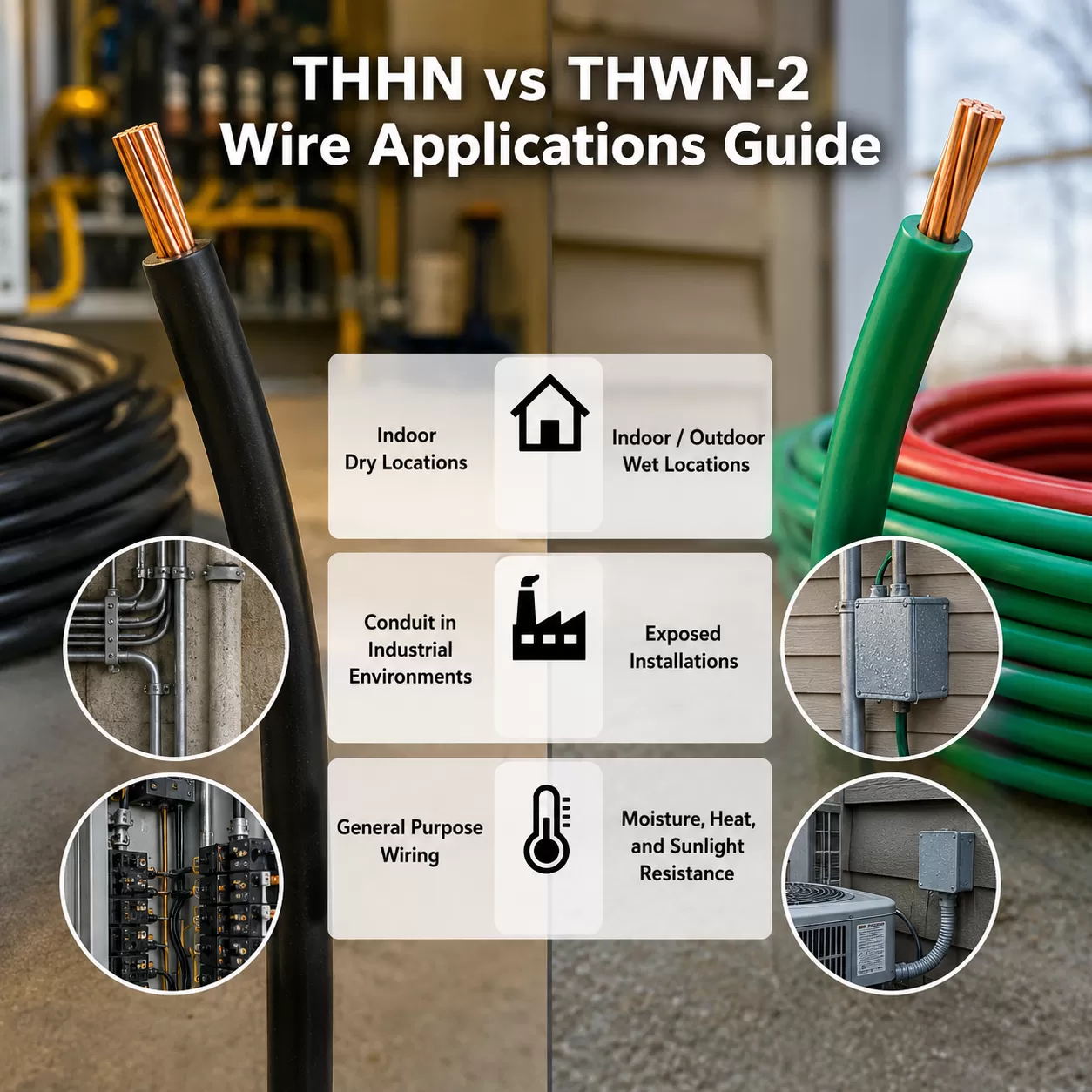
THHN, THWN and THWN-2 are North American thermoplastic building-wire designations. THHN is rated for dry locations at up to 90°C. THWN is moisture resistant and is generally associated with a 75°C wet-location rating. THWN-2 is rated up to 90°C in both wet and dry locations. A wire marked THHN/THWN-2 carries both designations, so the same conductor can be used under its THHN rating in dry locations and its THWN-2 rating in wet locations.
The temperature printed on the wire is an insulation rating. It does not, by itself, set the allowable circuit ampacity. Conductor size, terminal ratings, ambient temperature, the number of current-carrying conductors, overcurrent protection and the applicable electrical code still control the final design.
This page compares the three designations and their installation boundaries. For UL 83 scope, construction requirements, certification verification and detailed test checks, use our UL 83 THHN/THWN-2 wire standard guide.
THHN vs THWN vs THWN-2 comparison table
| Designation | Meaning | Dry-location temperature | Wet-location temperature | Typical selection boundary |
|---|---|---|---|---|
| THHN | Thermoplastic, high heat resistant, nylon covered | Up to 90°C | No wet rating under THHN alone | Protected dry-location conduit and raceway work |
| THWN | Thermoplastic, heat and water resistant, nylon covered | Commonly up to 75°C under the THWN designation | Up to 75°C | Wet or dry locations where a 75°C THWN rating meets the design |
| THWN-2 | Thermoplastic, heat and water resistant, nylon covered; -2 identifies the 90°C wet/dry class | Up to 90°C | Up to 90°C | Indoor, outdoor or underground conduit when the wiring method permits |
| THHN/THWN | Dual-rated construction | Up to 90°C under THHN | Up to 75°C under THWN | One product for 90°C dry and 75°C wet applications |
| THHN/THWN-2 | Dual-rated construction | Up to 90°C | Up to 90°C | One product for wet and dry conduit applications, subject to the complete marking and code |
These ratings describe the type designation. Oil, gasoline, sunlight, cable-tray, machine-tool and direct-burial suitability are separate claims and must appear where the applicable approval requires them.
What the letters mean
THHN meaning
THHN identifies a thermoplastic-insulated, high-heat-resistant, nylon-covered conductor:
T: thermoplastic insulation, commonly PVCHH: the high-heat classification associated with 90°C dry-location useN: nylon covering over the primary insulation
The nylon layer gives the surface abrasion resistance and helps the wire move through conduit. It does not turn a dry-rated conductor into a wet-rated or direct-burial product.
THWN meaning
THWN adds moisture resistance:
T: thermoplastic insulationH: heat resistantW: moisture resistantN: nylon covered
Traditional THWN is used for wet-location capability up to 75°C. When a product is marked THHN OR THWN, the THHN designation supports 90°C dry use, while THWN supports 75°C wet use.
What -2 changes
The -2 suffix is the practical difference between THWN and THWN-2. It identifies a wire evaluated for 90°C operation in wet as well as dry locations. The suffix should appear in the surface legend or other required product identification. A supplier’s quotation saying “equivalent to THWN-2” is not a substitute for the required designation and certification.
How location changes the selection
Start with the route, not the wire color. Two black PVC-and-nylon conductors may look the same but carry different location ratings.
| Installation route | Location condition to specify | Suitable designation to evaluate | Boundary to remember |
|---|---|---|---|
| Indoor conduit in a normally dry space | Dry | THHN, THWN or THWN-2, as permitted | Confirm the complete listing and circuit design |
| Outdoor conduit above ground | Wet-location conductor normally required | THWN or THWN-2 | Conduit does not make a dry-only conductor suitable for moisture |
| Underground conduit | Treat the conduit interior as wet | THWN or THWN-2 | The conductor still needs an approved raceway system |
| Direct contact with soil | Wet plus direct-burial approval | A construction specifically listed and marked for direct burial | THWN-2 alone does not establish direct-burial suitability |
| Exposed run without raceway | Depends on the approved wiring method and exposure | A product specifically permitted for that installation | Nylon-covered building wire is not a general outdoor jacketed cable |
| Dry residential wiring without a full conduit system | Normally dry | A complete cable assembly such as NM-B where permitted | Individual THHN/THWN-2 conductors and NM-B are different wiring methods |
For dry interior residential branch circuits, compare the conduit approach with our NM-B cable guide. Local code and the authority having jurisdiction decide which wiring method is accepted.
Conduit, underground conduit and direct burial
Indoor conduit
THHN and dual-rated THHN/THWN-2 are commonly pulled as individual conductors through approved conduit or raceway. The project still has to account for conduit type, fill, bends, pulling tension, conductor outside diameter and the number of current-carrying conductors.
A general rule such as “three or more conductors means 40% fill” is not enough for purchasing. The buyer needs the actual wire outside diameter and the selected raceway size so the installer can check the applicable conduit-fill table.
Outdoor and underground conduit
Water can enter an outdoor raceway through joints, temperature changes or condensation. Underground raceways are treated as wet locations even when the conduit is intended to be sealed. A conductor used there needs a wet-location designation such as THWN or THWN-2.
The choice between THWN and THWN-2 depends on the required wet-location temperature class and the rest of the circuit design. Specifying THWN-2 does not automatically authorize use of the 90°C ampacity column at equipment terminations.
Direct burial
Wet-location approval and direct-burial approval answer different questions. THWN-2 addresses moisture and temperature. Direct burial also involves soil contact, mechanical damage and the construction’s ability to withstand the stated underground use.
Do not place an individual conductor directly in soil because it says THWN-2. Require a cable or wiring method specifically approved for direct burial, and check the printed legend, packaging label, certification scope and local code. Depending on the project, that may mean UF-B, USE-2/RHH/RHW-2 or another listed direct-burial construction. These products are not automatic substitutes for one another.
Why dual-rated THHN/THWN-2 is common
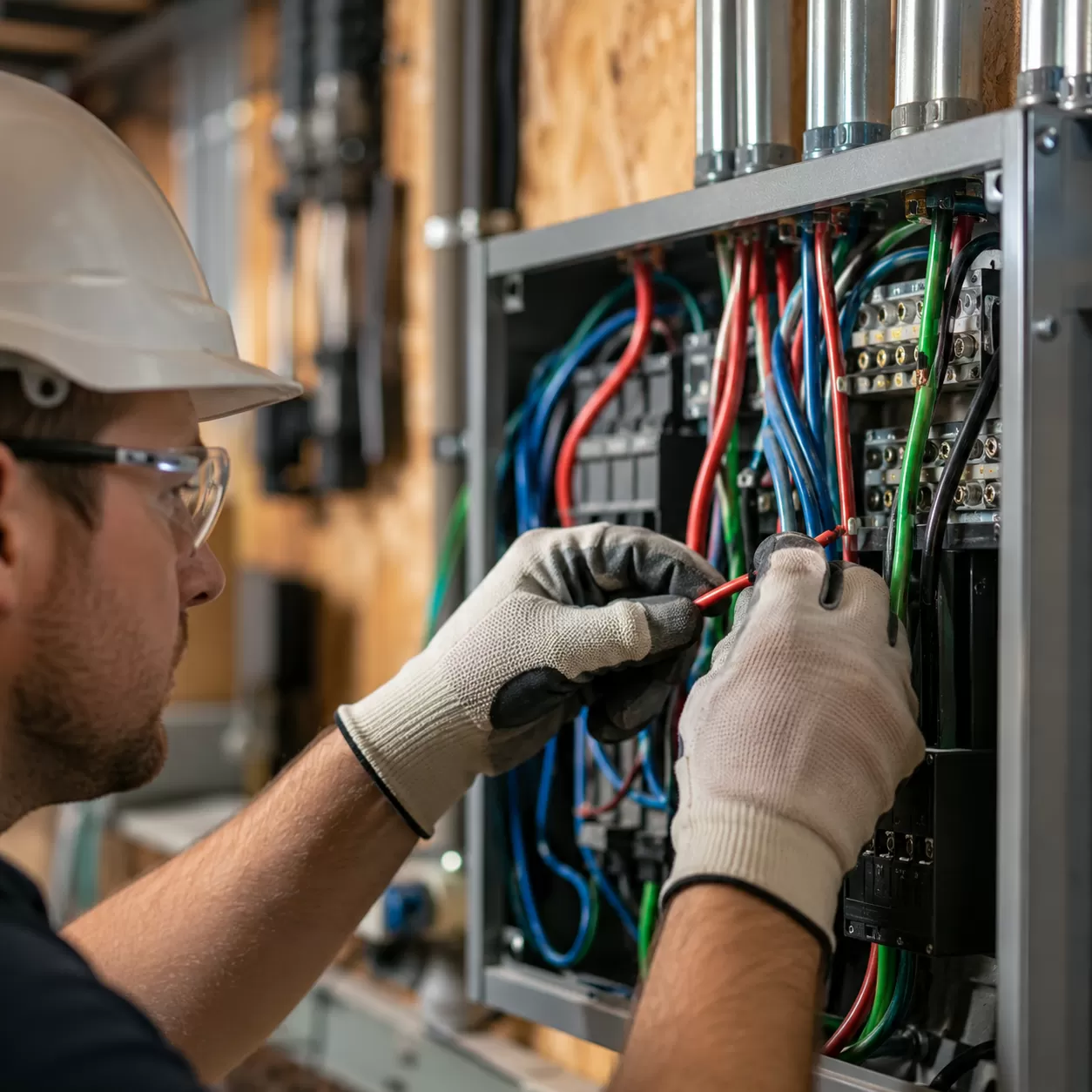
Many current building-wire products carry both THHN and THWN-2 designations. A distributor can stock one product for dry indoor conduit and wet-location conduit instead of managing separate dry-only and wet-rated lines.
The combined construction matters only when the marking and certification support it. A spool described informally as “THHN” may be dual rated, but the buyer should not infer THWN-2 from the PVC/nylon structure or from a supplier’s product name.
How to read the wire printing
A purchase-approved legend for a dual-rated product may contain information in this form:
MANUFACTURER / 12 AWG / CU / THHN OR THWN-2 / 600V / OPTIONAL RATINGS / TRACEABILITY
The exact order and wording depend on the product, certification and market. Check these items on the sample and the production wire:
- Manufacturer or authorized trademark
- AWG or kcmil conductor size
- Copper or aluminium conductor identification where required
- Full designation, including
THHN,THWNorTHWN-2 - Voltage rating
- Wet/dry and temperature information required by the approved construction
- Optional claims such as sunlight resistance, oil resistance, VW-1, CT, MTW or AWM only when supported
- Footage, date or batch traceability when included in the purchase specification
Do not verify the order from the surface print alone. Match the coil, reel or carton certification label to the manufacturer, file number, wire type and size covered by the approval. Our cable jacket markings guide explains how to review the full legend and approve custom printing.
Selection checks before choosing THHN, THWN or THWN-2
1. Define the route
State whether the conductor will run in indoor conduit, outdoor conduit, underground conduit, a cable tray, machinery or another approved wiring method. “For a building project” does not give the supplier enough information.
2. Classify the location
Confirm whether every section of the route is dry or wet. If part of the raceway is outdoors or underground, specify the required wet-location rating for that section.
3. Confirm the temperature designation
Use THWN when a 75°C wet rating matches the design. Specify THWN-2 when the project requires a 90°C wet and dry designation. Keep insulation temperature separate from final allowable ampacity.
4. Check the complete product marking
Read the actual line print. Do not assume that all modern THHN is also THWN-2. Verify any extra claims needed for sunlight, oil, gasoline, tray or machine-tool use.
5. Confirm the wiring method boundary
Ask whether the conductor requires conduit, whether the selected conduit is approved for the environment and whether the route includes direct soil contact. If it does, request a specifically approved direct-burial solution rather than relying on a THWN-2 marking.
Procurement checklist for a quotation
Send the following details when requesting pricing:
- Destination country, applicable code and required certification
- Exact wire designation: THHN, THWN, THWN-2 or THHN/THWN-2
- Rated voltage and required dry/wet temperature classification
- Conductor material, AWG or kcmil size, solid or stranded construction, and strand details where required
- Installation route: indoor, outdoor or underground conduit; tray; equipment; or direct burial
- Required optional ratings such as sunlight resistance, oil resistance, gasoline resistance, VW-1, CT, MTW or AWM
- Insulation color and quantity by color
- Coil or reel length, total quantity and allowed length tolerance
- Approved surface-print legend, private label and traceability format
- Required certificate record, datasheet, sample, batch test report, resistance report and dimensional report
- Packing format, reel label, pallet requirement and destination shipping marks
Use the UL 83 standard page when you need the detailed standard, certification and inspection checklist.
Sample THHN/THWN-2 RFQ
Product: UL 83 THHN/THWN-2 building wire
Rating: 600V, 90°C wet and dry
Conductor: bare annealed copper, _ AWG, solid/stranded Color and quantity:
Installation: indoor/outdoor/underground conduit
Additional ratings required: Coil or reel length: ft
Surface print and private label: Required documents: certification record, datasheet, sample report, conductor resistance and dimensional report Packaging and shipping marks:
Destination market: __
The supplier should return a line-by-line specification instead of confirming only “THHN cable available.”
Frequently asked questions
What is the main difference between THHN and THWN-2?
THHN provides a 90°C dry-location designation. THWN-2 provides a 90°C wet-and-dry designation. A dual-rated THHN/THWN-2 conductor carries both.
What is the difference between THWN and THWN-2?
THWN is generally rated up to 75°C in wet locations. THWN-2 is rated up to 90°C in wet and dry locations. The -2 suffix must be verified in the product marking and approval.
Can THHN wire be installed in outdoor conduit?
A standalone THHN designation does not prove wet-location suitability. For outdoor conduit that is a wet location, use a conductor carrying an appropriate wet designation such as THWN or THWN-2, subject to the approved wiring method and local code.
Can THWN-2 wire be installed in underground conduit?
THWN-2 may be used as the wet-rated conductor in an approved underground raceway system when the applicable code and product listing permit it. The conduit, fittings, burial depth, conductor sizing and circuit protection still require project-specific review.
Can THWN-2 wire be buried directly in soil?
Not on the strength of the THWN-2 marking alone. Direct burial requires a construction and wiring method specifically approved for soil contact.
Does a 90°C THWN-2 rating mean I can size every circuit from the 90°C ampacity column?
No. The insulation rating is one input. Terminal temperature limits, conductor size, ambient temperature, grouping, equipment rules and the applicable code may set a lower allowable ampacity.
Is every modern THHN wire also THWN-2?
No. Dual-rated products are common, but the full THHN/THWN-2 designation must be verified on the wire and in the certification record.
For a quotation, send your target market, exact designation, conductor size, colors, quantity, package length, installation route and documentation requirements through the KingForYou Cable contact page. You can also review the current THHN/THWN building-wire product page before preparing the RFQ.


